
These are common services most people utilize and pay for and often pay more than necessary without thinking. It’s possible to utilize these services for a lot less than you might think.
Cable
For me, the cable is eliminated. I don’t typically watch tv so in our household, it’s an unnecessary expense. We do watch movies and some show series on occasion, so we do use the TV. But if you have internet service, there are lots of free or inexpensive services you can use like. Do a google search for free streaming services and you get a list like this.
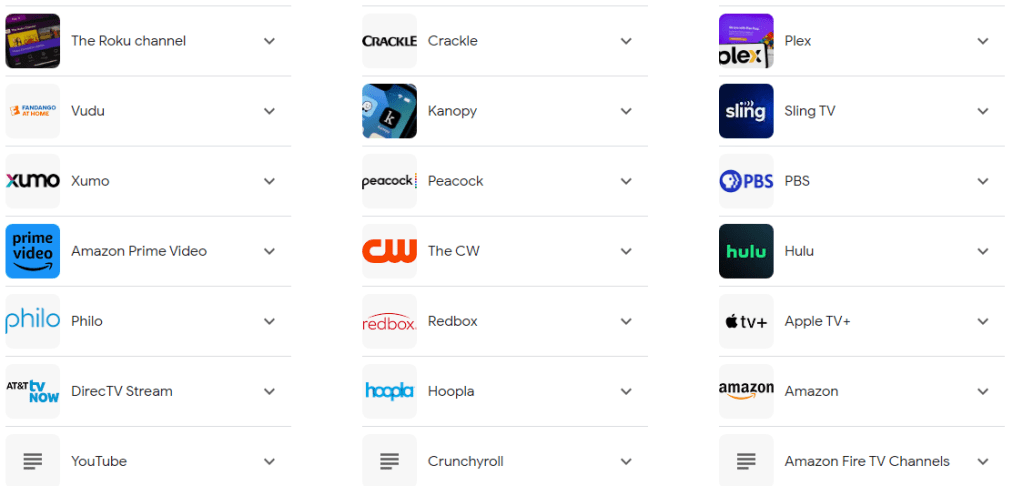
go to your browser and type free streaming services or browse available apps on your tv.
If you have a smart tv of some sort, you should have no problem downloading any of them if they’re not already installed. There’s probably commercials on most of them, but there’s commercials on cable and you’re willing to pay for that. Why not do it free?
Some of these will want you to sign up for a subscription but if it has a totally free version, get that. Even with a subscription or two, you’ll pay a lot less than you would with a cable bill, and you can generally watch what you want on demand.
But if you’re going to subscribe, browse what’s available before you do and choose only the ones you’re most likely to use. There’s no sense in paying for it if you never open it.
Internet
This is definitely a necessity in our house. I work from home a lot and also use it to manage this website. If you work from home at all, don’t forget that part of this expense, as well as utilities, phone and rent or mortgage is possibly a tax write off for you. Don’t throw away those bills until you look into this. Keep an eye out for that post in the future.
But internet doesn’t have to be a major expense. Do your research and shop around for the best deal. Sometimes you can bundle it with your phone service and save money but make sure you research your options before you assume it’s the best deal.
If you do have standalone service, or if you have choices on levels of service, choose the least expensive option that will serve your needs. Unless you’re running a business from home that requires an insane amount of data, you don’t need the top dollar option.
Most plans are unlimited anyway, but some of them claim high speed up to a certain point and then slow down once your data usage hits the limit. Look at your bill or call your service provider to find out what your average usage is, and use that to decide if you really are on the right plan for you.
Phone
Most households don’t have landlines anymore. Everyone seems to have a cell phone. It’s more convenient and you carry your service with you. But this doesn’t have to be a large expense either.
Most cell phone plans already come with unlimited talk, text, and data. Although, like internet, it may be unlimited data that slows down at a certain point. Again, look at your average usage. If your phone is on Wi-Fi most of the time, at home, work, or wherever you normally are, you probably don’t use as much data as you think. And you can change your settings not to download things unless you’re on Wi-Fi.
Keep in mind that pre-paid plans are typically cheaper than post-paid plans, and you know exactly what you’re getting and for how much. The price doesn’t change from month to month. Post-paid plans often fluctuate and they seem to enjoy raising their prices.
Post-paid plans try to reel you in by offering you a “free” or discounted phone if you sign up for their service. But they lock you into a contract that charges a monthly payment for the phone, and add a credit to your bill equal to that amount. What they don’t tell you is that they charge taxes, surcharges and other fees based on the total cost prior to the credit, not to mention, your phone will be locked to that carrier until it’s “paid off.” On top of that, the plans you pay for are almost always more expensive and you’re stuck in a contract. In the end, you will pay a lot more for that “free” phone than you would have if you’d have just bought it in the first place.
Regardless of the phone plan, add-ons can cost you a lot of money as well. Phone insurance can be expensive. Before deciding to take this option, add up the total cost for 1 year and see if it’s worth it to you to pay that price on the off chance you need to use it. Read the fine print to see what it actually covers. You might unwittingly find that when you try to use the insurance for a mishap, it doesn’t cover the thing that happened to your phone. Many times there is a deductible and more often than not, you won’t get a replacement right away, even if the insurance does cover the issue.
And watch out for other perks that might be offered. Even if they are “free,” you will pay taxes and surcharges for them. If they’re not free, you might look into how much it would cost to get them on your own, or even consider whether you really need them. It doesn’t make sense to pay for things you rarely use.
If you do have add-ons to your plan, you might also want to find out whether or not you have to manually cancel them through the partner service if you choose to change carriers. If you don’t pay attention, you might find yourself with bills from places you didn’t even know you did business with.
Summary
Don’t pay for anything more than exactly what you need. Do your research. Get all the details. Read the fine print. Don’t lock yourself into a bad deal. Preferably, don’t lock yourself in at all. You shouldn’t be stuck in a contract of any sort. You should be free to take the best deal available. You’re not married to these services. Keep your options open. And don’t insure anything you can afford to replace. Sometimes the risks are better than the cost of protection.
 Ashes 2 FIRE
Leave a comment